Chetan Payyavula
Computer science · University of Cincinnati

Software for
fast cars

I build data, simulation and visualisation tools for motorsport: lap telemetry, race strategy, hybrid energy management and the regulations that shape the cars.

Focus
Motorsport data & simulation
Studying
Computer science, UC
Builds in
Python · JavaScript · three.js
Looking for
Internships & placements

Work

4 projects
01 · Interactive 3D site

Aero Atlas

How Formula 1's rules shaped the cars, from the 1961 1.5-litre formula to the 2026 active-aero cars, in one interactive 3D model.

  • three.js
  • JavaScript
  • Procedural 3D geometry
  • Data research
66seasons modelled
919team-seasons in the grid data
25radical designs explained
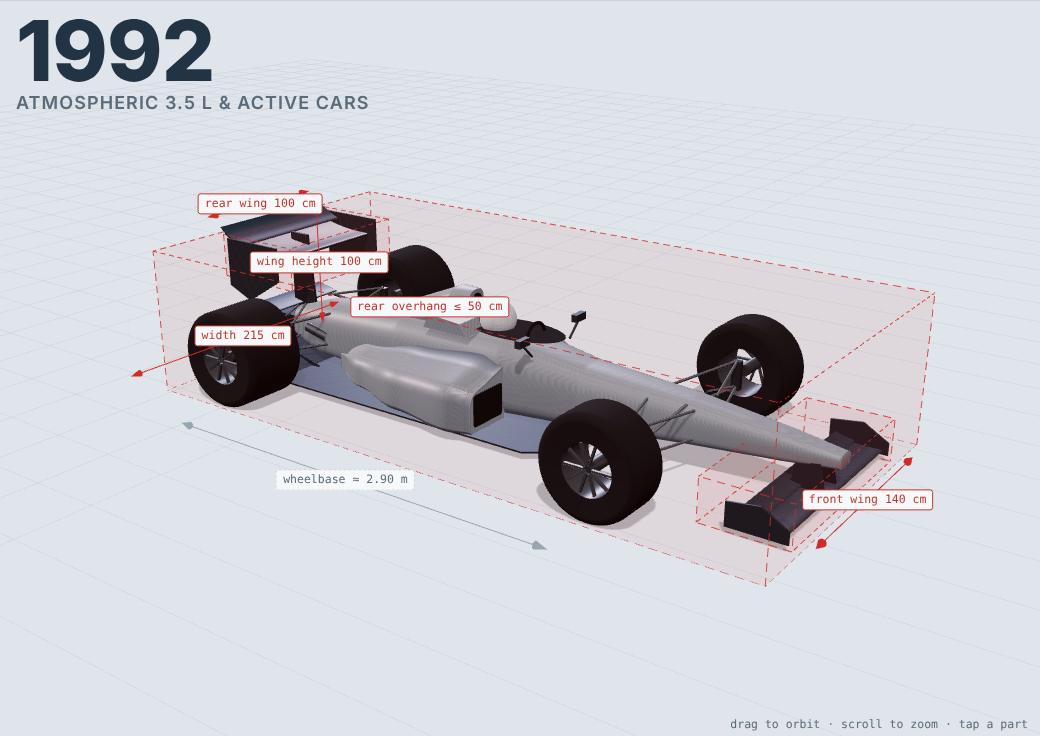
  • Builds a regulation car for every season from that year's FIA figures (width, wing spans and heights, overhangs, wheelbase, tyres, weight), with a cited source on every number and both values shown where sources disagree.
  • All geometry is generated in code: lofted chassis and sidepod sections, NACA-style aerofoils, lathed tyres, and era-specific details such as skirts, grooved tyres, the halo and 2026 movable wings.
  • "Legal box" view of the space the rules allow, an illustrative airflow view, era comparison as a ghost overlay, and every season's grid from the open F1DB dataset.
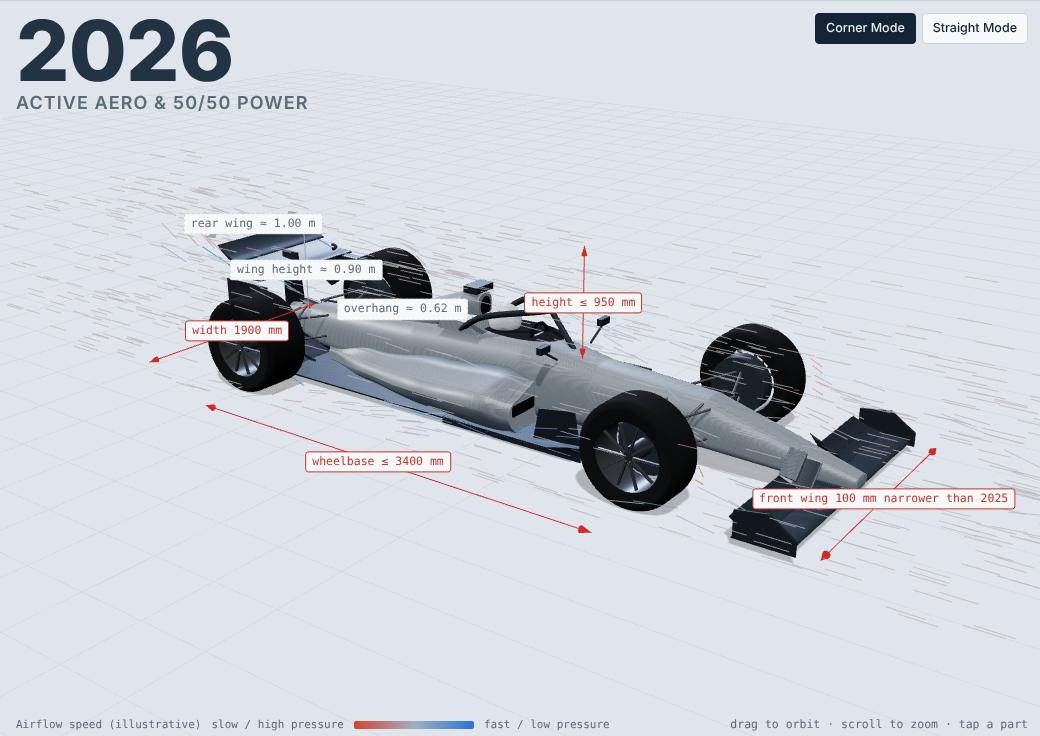
Aero Atlas showing the 2026 regulation car with dimension lines for width, wheelbase, height and front wing
2026 car with rulebook dimensions and the airflow view
Aero Atlas showing the 1992 car inside the red legal-box overlay
1992 car inside the space the rules allowed
02 · Full-stack web app

Pitwall

An F1 telemetry lab: compare any drivers' laps from real timing data, replay them in 3D, and run a live strategy pit wall.

  • Python
  • FastAPI
  • FastF1
  • OpenF1
  • Pyodide
  • Plotly
  • three.js
53automated tests
4drivers compared at once
6analysis tabs
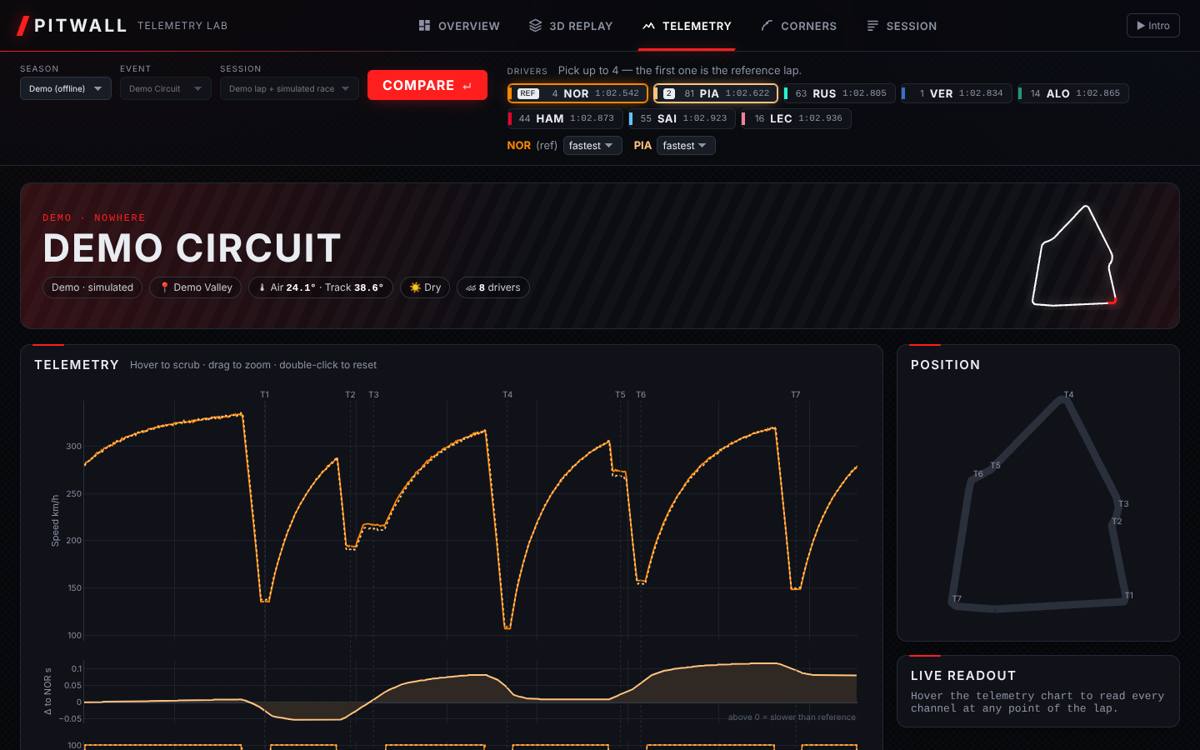
  • Lap comparison from official timing data: speed, throttle, brake and gear traces, lap-time delta, track dominance, braking zones and corner-by-corner analysis. The fastest lap is always the reference.
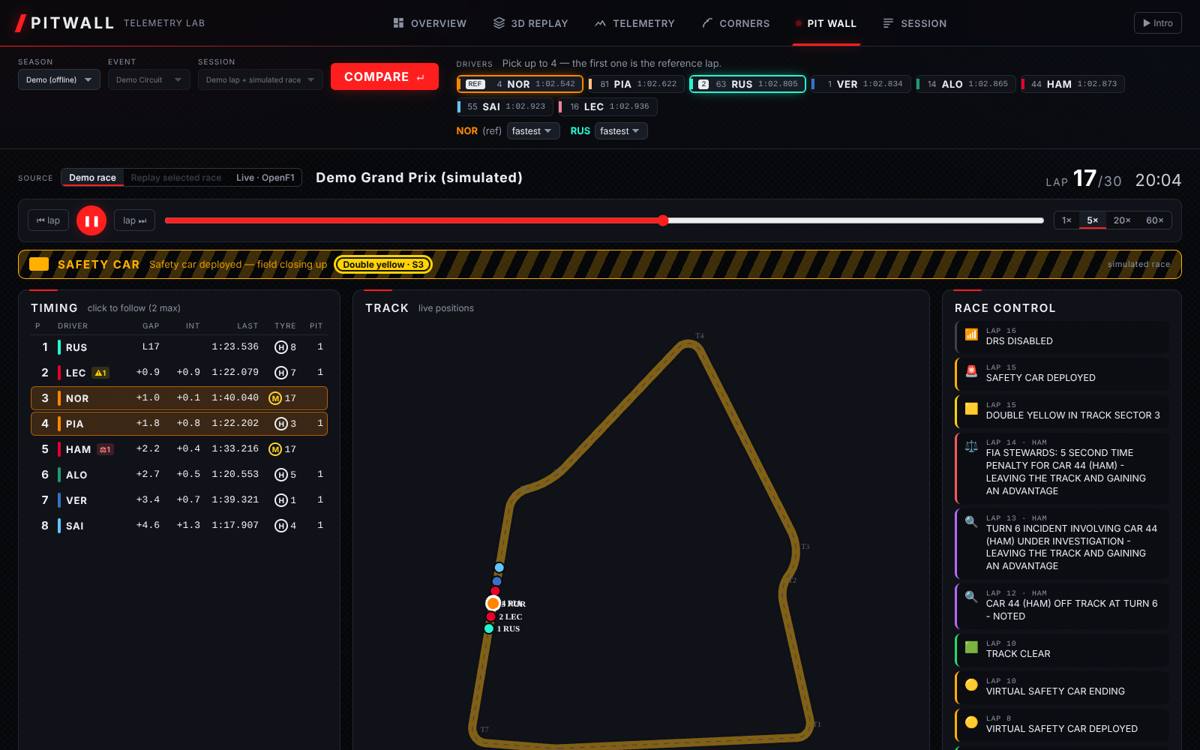
  • Pit wall strategy engine: fuel-corrected tyre-degradation fits, undercut and overcut calls, rejoin position, pit window, safety car and VSC time loss, and an ERS estimate.
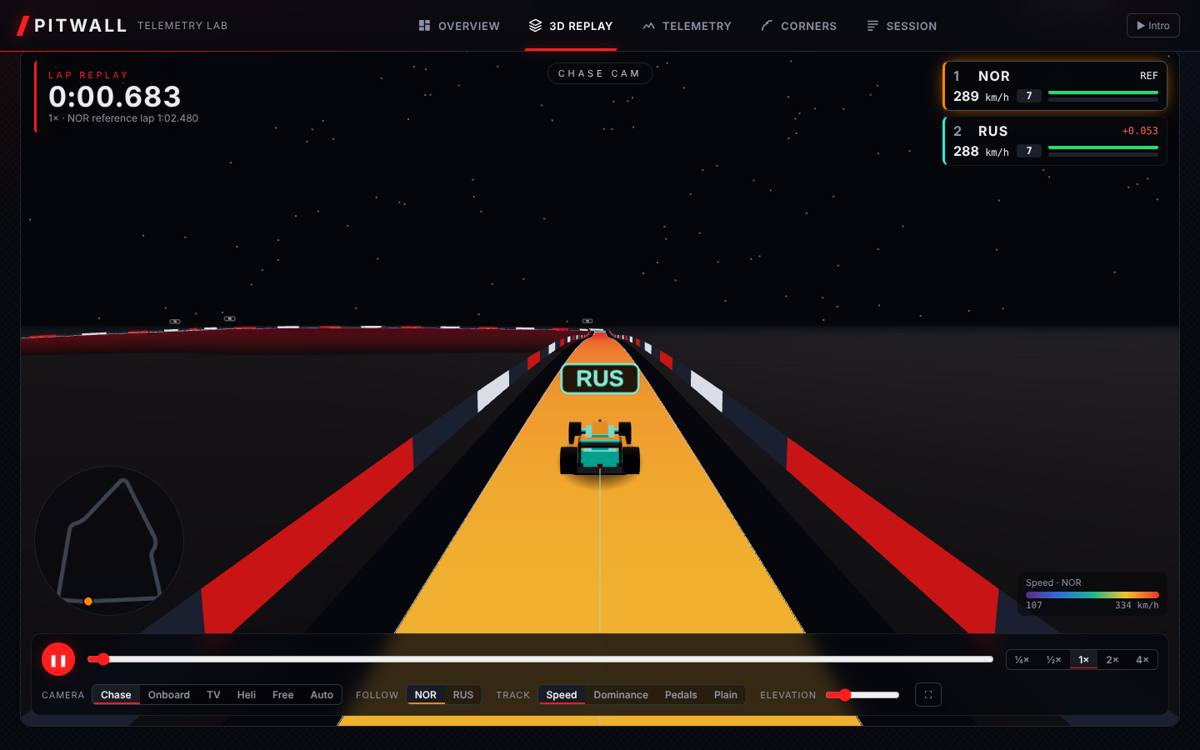
  • 3D lap replay with chase, onboard and TV cameras; race replays from past data, and support for a live OpenF1 feed within its rate limits.

The online version runs the same Python analysis in your browser (Pyodide) on 8 recorded sessions; run it locally for any session and live timing.

Pitwall telemetry tab with speed traces of two drivers and a track map
Telemetry: speed traces, delta and track position
Pitwall live pit wall with timing tower, track map and race control messages
Pit wall under a safety car
Pitwall 3D lap replay in chase camera
3D lap replay
03 · Simulation

Hybrid Energy-Management Simulator

How should an engine and an electric motor share the load? A simulator that tests energy-management strategies against the best possible one.

  • Python
  • NumPy
  • Dynamic programming
  • ECMS
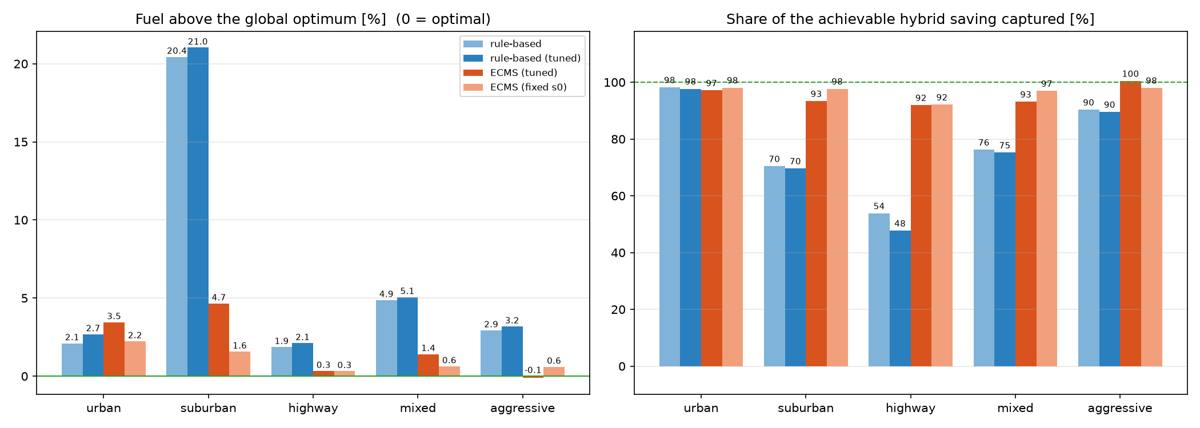
0.3–4.7%ECMS gap to the optimum
15.8%fuel saved on a mixed cycle
26physics & regression tests
  • Quasi-static model of a parallel turbo-hybrid: drag, rolling resistance, Willans-line engine, MGU-K, battery equivalent circuit and an MGU-H.
  • Compares rule-based control, ECMS and a dynamic-programming benchmark priced fairly on stored energy. ECMS captures 92–100% of the achievable hybrid saving.
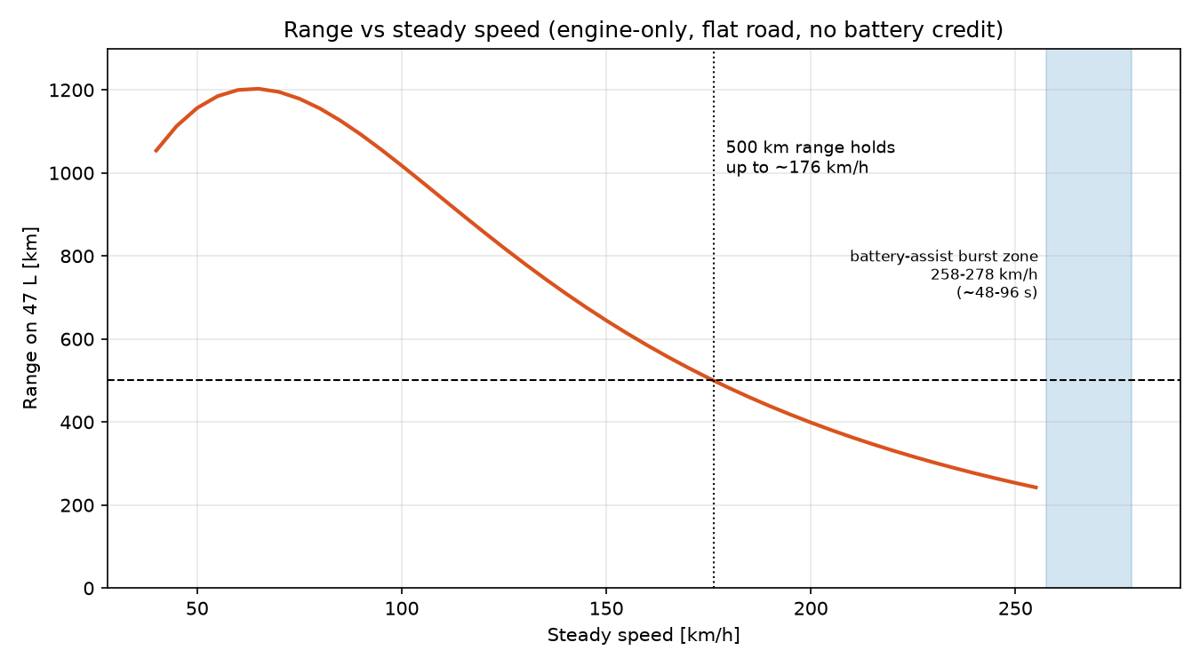
  • Checked the class report's claims: 280 km/h and 500 km range are two different operating points, and 500 km holds only up to about 176 km/h steady.
Chart of each controller's fuel gap to the dynamic-programming optimum across five driving cycles
Gap to the global optimum, by controller and cycle
Chart of range against steady speed
Range against steady speed
04 · Engineering design

Petrol Turbo-Hybrid Powertrain

A class project to design a vehicle powertrain, taken from concept to CAD model and scale build.

  • CAD
  • Vehicle dynamics
  • Technical report
  • Ruled out an early self-charging wind-turbine concept on conservation of energy: pulling energy from the car's own airflow costs more drag than it recovers.
  • Sized power at speed from the drag power equation P = ½ρCdAv³, then iterated through combustion, battery-electric and hybrid layouts.
  • Settled on a petrol turbo-hybrid as the best balance of range, performance and feasibility, then built the simulator above to test the report's numbers.
Design path
Wind-turbine concept ✕
F1-style combustion →
Battery-electric →
Petrol turbo-hybrid ✓
P = ½ · ρ · Cd · A · v³

About

background

I'm a computer science student at the University of Cincinnati. I care about the point where software meets machines that go fast: the data that tells a race engineer what the car is doing, the models that decide how a hybrid spends its energy, and the rules that decide what the car can look like.

Outside class I'm Head of Growth and Marketing at AgriMeta, a startup I've worked on since 2021. In high school I ran public awareness programs on student mental health, environmental pollution and women's safety.

How I build

I use AI coding agents as a pair programmer. I set the scope, pick the data sources, decide what "correct" means and write the checks; every figure on these projects is traced to a source or a test.

Toolkit

Languages
Python, JavaScript, HTML/CSS
Data
FastF1, OpenF1, pandas, NumPy, Plotly, Matplotlib
Web
FastAPI, three.js, static sites, Vercel, GitHub Pages
Modelling
Vehicle dynamics, hybrid energy management, dynamic programming, ECMS
Practice
Automated testing, source-checked data, technical writing

Let's talk
motorsport software

payyavulachetan@gmail.com GitHub ↗